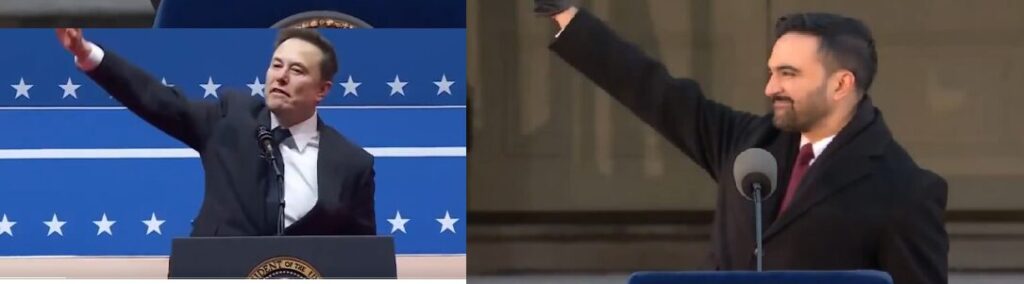
When Elon Musk briefly raised his arm during a public appearance earlier this year, the media response was instant and ferocious. Headlines, panels, and social media pile-ons raced to suggest—sometimes outright state—that Musk had delivered a “Nazi salute.” The accusation spread far and wide, despite the obvious context: a fleeting, awkward gesture during a speech, with no ideological content, no extremist messaging, and no supporting evidence of intent. Facts didn’t matter. The narrative was too useful.
Fast forward to New York City.
At his swearing-in ceremony and victory speech, newly elected Mayor Zohran Mamdani made a hand-and-arm gesture strikingly similar to the one that triggered weeks of outrage over Musk. The clip went viral almost immediately. Side-by-side comparisons flooded X. The resemblance was obvious enough that even casual observers noticed it.
And yet—silence.
No media meltdown. No breathless speculation. No experts rushed onto cable news to decode Mamdani’s body language. No insinuations about extremist sympathies. No “questions raised” headlines. Just a collective shrug from the same institutions that had spent days interrogating Elon Musk’s wrist angle.
That contrast is the story.
Mamdani’s defenders are correct about one thing: there is no evidence that his gesture carried any extremist meaning. But that was also true in Musk’s case. The difference is not the gesture. The difference is who made it.
When Musk—a billionaire entrepreneur aligned with free speech absolutism and openly critical of the left—made a similar motion, the worst possible interpretation was immediately assumed and aggressively promoted. Context was ignored. Intent was presumed. Guilt was treated as self-evident.
When Mamdani—a young, progressive Democrat and the first Muslim mayor of New York City—made nearly the same gesture, the media suddenly remembered how gestures work. Context mattered again. Intent was required. Accusations were dismissed as politically motivated or unserious.
Conservative commentators quickly pointed out the double standard. Jeffrey Mead noted that Musk was effectively tried and convicted in the court of public opinion for a momentary hand movement, while Mamdani received near-total media immunity. Popular accounts like Libs of TikTok and Planet of Memes posted side-by-side clips, using irony and silence to make the point the press refused to address.
The cricket emojis weren’t subtle.
This isn’t about claiming Mamdani is a Nazi. He isn’t. It’s about asking why the media was so eager to flirt with that label when it came to Musk—and so determined to avoid even discussing it when the shoe was on the other foot.
The explanation is simple and uncomfortable: the modern media no longer applies standards consistently. It applies them politically.
If you are on the wrong side of the ideological divide, ambiguity will be weaponized against you. Innocuous behavior will be framed as sinister. If you are on the “right” side, the same ambiguity will be ignored, contextualized, or explained away.
That’s not journalism. That’s narrative enforcement.
Mamdani’s administration has said it will focus on affordability, public services, and economic equity. Fine. Those policies should rise or fall on their merits. But the media’s refusal to apply the same scrutiny it eagerly imposed on Musk reinforces what millions of Americans already believe: the press is no longer interested in fairness, only alignment.
The viral clips didn’t expose extremism. They exposed bias.