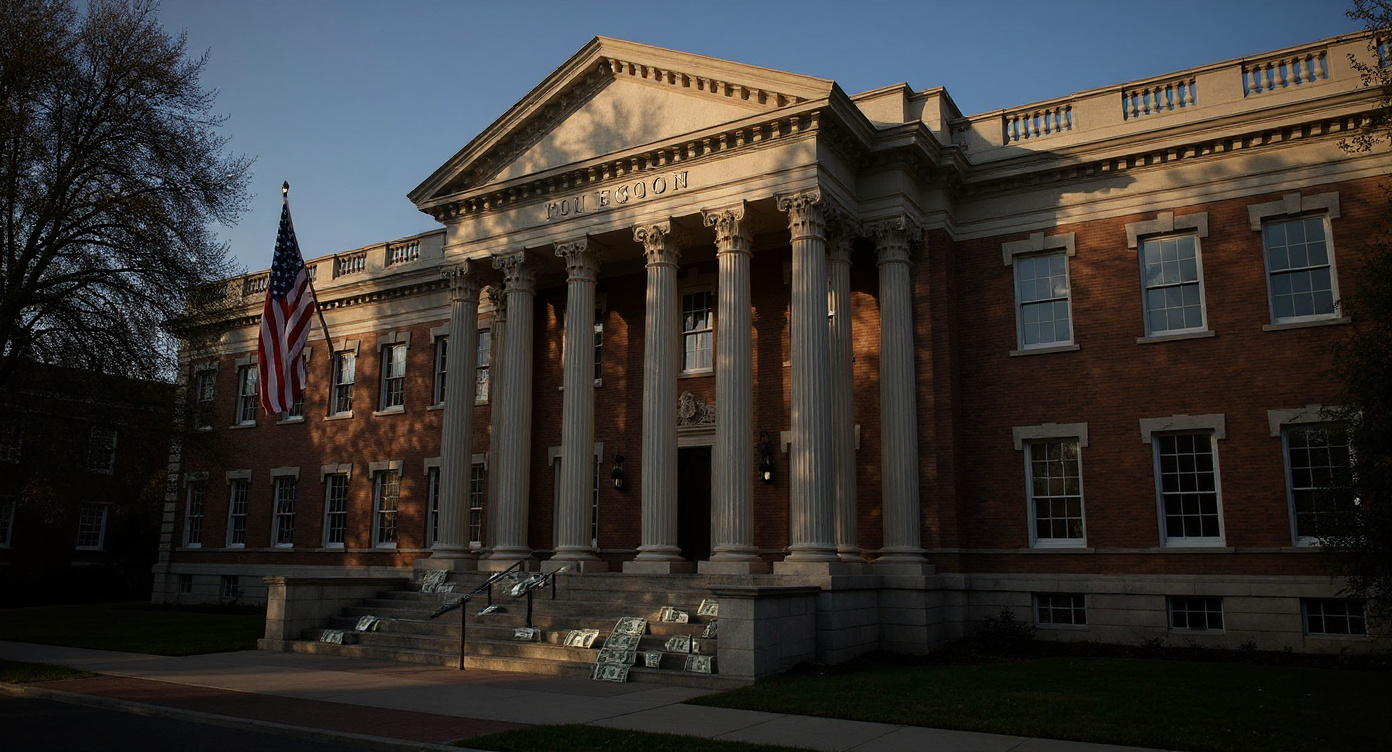
The Skolkovo Foundation — a Russian tech initiative so cozy with the Kremlin that the FBI once warned it could be used for espionage — wired $51 million to American universities. Beijing Institute of Technology, which works directly with China's military, sent another $44 million. Air China kicked in $33 million. Grand total from foreign entities on U.S. government watchlists: north of $300 million.
Your kid's meal plan went up twelve percent.
Federal data published this week by the U.S. Department of Education reveals that American universities accepted approximately $380 million in donations from foreign entities, of which 697 transactions — totaling over $300 million — involved what the department classifies as "Counterparties of Concern." That's the polite bureaucratic term for organizations linked to governments that don't particularly like us. The data was reported by The College Fix, and the numbers are as ugly as you'd expect.
Sixty-seven universities took the money. The biggest recipient was MIT, hauling in roughly $80 million. UC Berkeley collected $27 million, including $7 million from China's Sun Yat-sen University alone. These aren't community colleges scrounging for lab equipment. These are elite institutions with endowments the size of small countries' GDPs, and they're still cashing checks from Beijing and Moscow like they're running a tip jar.
Dan Mogulof, Assistant Vice Chancellor at UC Berkeley, offered the kind of response you'd expect from a university PR office caught with its hand in a foreign cookie jar. "What we can unequivocally state is that UC Berkeley complies with all of the statutes and regulations that apply to contracts and gifts from foreign sources, and to all reporting requirements," Mogulof said. He added that the university does not accept restrictions on "the freedom to publish" and that resulting information "is to be shared broadly within the scientific community."
Shared broadly. With the scientific community. Including, apparently, the scientific community that builds hypersonic missiles for the People's Liberation Army.
Angela Morabito, a spokesperson for the Defense of Freedom Institute and former U.S. Department of Education press secretary, was considerably less diplomatic. "College leaders should know where every dollar is going, especially when those dollars come from hostile foreign powers," Morabito said. "Academic freedom and national security cannot be afterthoughts considered only after the check clears."
The reporting requirements Mogulof referenced come from the Higher Education Act of 1965, which mandates disclosure of foreign gifts and contracts above certain thresholds. The problem has never been the law's existence — it's been enforcement, which for decades was roughly as aggressive as a campus parking ticket. President Trump signed an executive order in April 2025 aimed at tightening oversight, and Congress has introduced the DETERRENT Act, which Morabito said "would strengthen reporting requirements and penalize institutions that aren't honest about their foreign financial ties."
The usual defense from the university crowd is that this money funds "open research" with no strings attached. Which is an interesting position to take about $51 million from a Russian foundation the FBI flagged as a potential espionage pipeline, or $44 million from a Chinese institution that exists to advance military technology. Open research is a nice concept right up until the country funding it has an active program to steal your intellectual property.
Here's what the universities conspicuously never explain: if the research is so open and the money is so clean, why did it take federal data disclosures to find out about it? Why weren't these partnerships trumpeted in alumni magazines between the photos of new rock-climbing walls and meditation gardens?
Sixty-seven schools. $300 million. From watchlisted entities. And every one of those schools will send you a fundraising letter next month asking for fifty bucks to support the annual fund.
The checks from hostile foreign powers cleared just fine. Yours is the one they'll follow up on.