
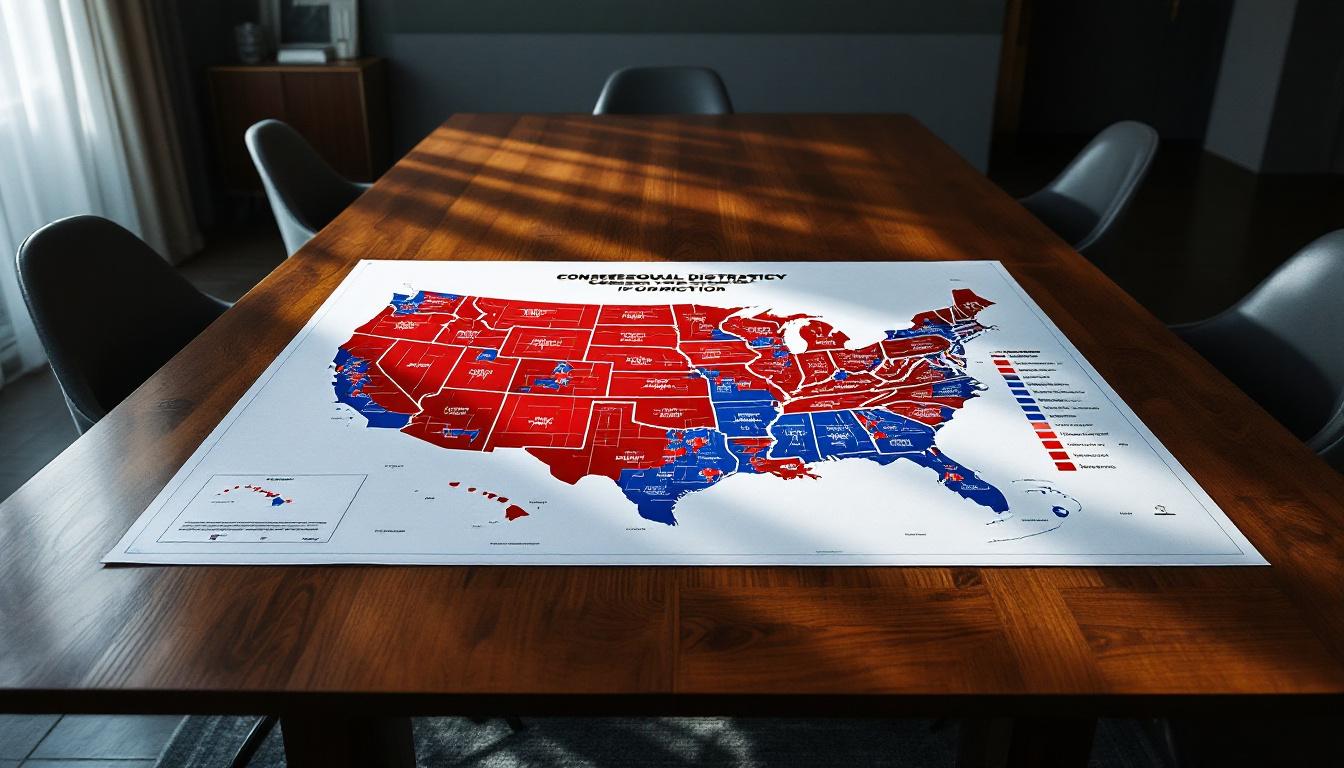
When CBS News — yes, that CBS — publishes an analysis admitting that Republicans are dominating the redistricting battle heading into the 2026 midterms, you know the Democrats are in deep, deep trouble. According to CBS elections analyst Anthony Salvanto, the GOP has locked in a structural advantage that could hand them between 10 and 16 extra House seats before a single ballot is cast.
Imagine being a Democrat strategist right now. Your own side's media is printing your obituary and you haven't even picked out your campaign yard signs yet.
Here's the math, and it's brutal. Texas, Florida, Ohio, North Carolina, Tennessee, and Missouri have all redrawn their maps in Republicans' favor, netting the party somewhere between 10 and 16 additional U.S. House seats. Democrats managed to claw back gains in exactly two states — California and Utah — for a measly four to six seats. That's it. Two states against six, and Democrats are still underwater.
The net effect? CBS's own analysts estimate a Republican gain of roughly seven seats on the new maps alone, though it could go higher. As Kyle Kondik — CBS News contributor and managing editor of Sabato's Crystal Ball at the University of Virginia Center for Politics — put it, his "best guess" is "a Republican gain of seven seats, but there's a range on that. It could be a little lower, it could be a lot higher than that."
Music to our ears.
The current projection gives Republicans an estimated 211-to-208 seat advantage before you even factor in the roughly 16 toss-up seats still in play. You need 218 to control the House. So Republicans need to win just seven of those 16 toss-ups. Democrats need to win ten. I'm no mathematician, but I like our odds.
Watch the segment for yourself...
Blaze News's Carlos Garcia noted that even legacy media outlets are being forced to acknowledge what conservatives have known for months — the GOP played the redistricting game smarter, harder, and better. The Supreme Court's ruling in Louisiana v. Callais blew the doors open even wider, allowing states like Louisiana, Alabama, Tennessee, and Mississippi to redraw maps that had previously been locked in by court orders favoring Democrats.
In Florida alone, Governor Ron DeSantis helped engineer maps that could deliver up to four additional Republican seats. Texas went even bigger, carving out five new districts designed to flip red. Some of those Texas districts include areas where Hispanic voters swung hard toward Trump in 2024 — and the question is whether those voters show up for midterms the same way.
Now, CBS did try to sprinkle in some copium for their audience. Kondik cautioned that "that's good for Republicans, but it's not enough if it continues to be a wave-style political environment." CBS anchor Major Garrett even suggested "this is a competitive map, and Republicans may come to regret some of these decisions." Sure, Major. And maybe the Detroit Lions will win the Super Bowl this year.
Here's what they're really saying between the lines: even if Democrats catch a favorable political wind, the structural advantage Republicans have built through redistricting might be enough to hold the House anyway. That's what keeps Nancy Pelosi's successor up at night.
The left spent years screaming about gerrymandering when they didn't control the maps. Now that Republicans have outmaneuvered them in state after state — legally, constitutionally, and with the Supreme Court's blessing — suddenly redistricting is an existential threat to democracy. Funny how that works.
The bottom line is simple. Republicans are playing chess while Democrats are still trying to figure out which piece is the horsey. And when CBS is the one telling you the game is already half over, you'd better believe the scoreboard is real.