
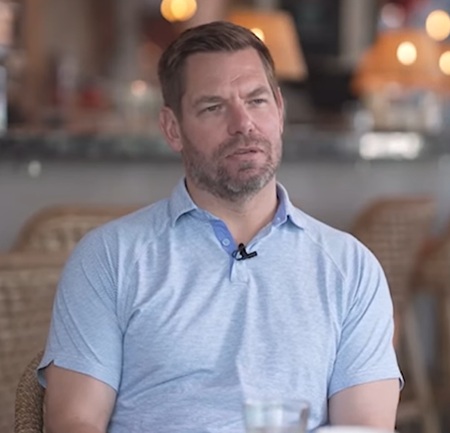
Eric Swalwell was walking through San Francisco International Airport on Saturday when FBI agents stepped into his path. The 45-year-old former Democratic congressman from California was cooperative, according to sources who witnessed the encounter. By Sunday, federal agents were inside his Northeast Washington, D.C. residence executing a search warrant.
They seized his cellphone and other electronics.
The Department of Justice opened the federal criminal investigation in April right as Swalwell resigned from Congress and dropped out of the California gubernatorial race. Multiple women have accused Swalwell of rape, sending inappropriate pictures and texts to them and unwanted touching. No charges have been filed as of this writing, and Swalwell has denied the allegations.
What makes this more than a standard federal investigation is the sheer breadth of agencies involved. The FBI is running point, but the Manhattan District Attorney's Office and the Los Angeles County Sheriff's Department are also part of the investigative apparatus. That's federal and local law enforcement across three jurisdictions — New York, Los Angeles, and Washington — all converging on one former member of Congress.
That kind of multi-jurisdictional coordination doesn't happen because someone filed a nuisance complaint. It happens when investigators believe there's a pattern worth tracing across state lines.
Swalwell, of course, is no stranger to federal scrutiny. This is the same man who sat on the House Intelligence Committee — with access to some of America's most sensitive classified material — while maintaining a sexual relationship with Chinese intelligence operative Christine Fang, better known as "Fang Fang." Democrats never removed him from the Intelligence committee, even after being briefed on his escapades with Fang Fang and the fact that she had fled back to China. He was never investigated by the House Ethics Committee. He simply carried on, voting on national security matters while the counterintelligence community quietly flagged his associations.
Now he's having his electronics seized.
The airport confrontation is a notable tactical choice by the FBI. Approaching a subject at an airport — rather than at his home or office — limits his ability to destroy evidence before agents arrive. The follow-up search warrant on his D.C. residence the very next day suggests the cellphone seizure was phase one of a coordinated sequence, not a standalone event.
Swalwell's defenders will point out that no charges have been filed. That's true. A search warrant is not a conviction. But a search warrant is also not a fishing expedition — it requires a judge to find probable cause that evidence of a crime exists at the location to be searched. The FBI didn't walk into SFO on a hunch.
For years, Swalwell positioned himself as one of the most aggressive voices on "accountability" in Congress. He sat on the impeachment panels. He went on cable news nearly every night to lecture the country about the rule of law. He called political opponents threats to democracy while his own security clearance sat on a foundation that would have disqualified a GS-12 analyst at Langley.
Three jurisdictions. A seized phone. A search warrant executed within 24 hours of initial contact. Whatever this investigation produces, the machinery around it is not casual.