
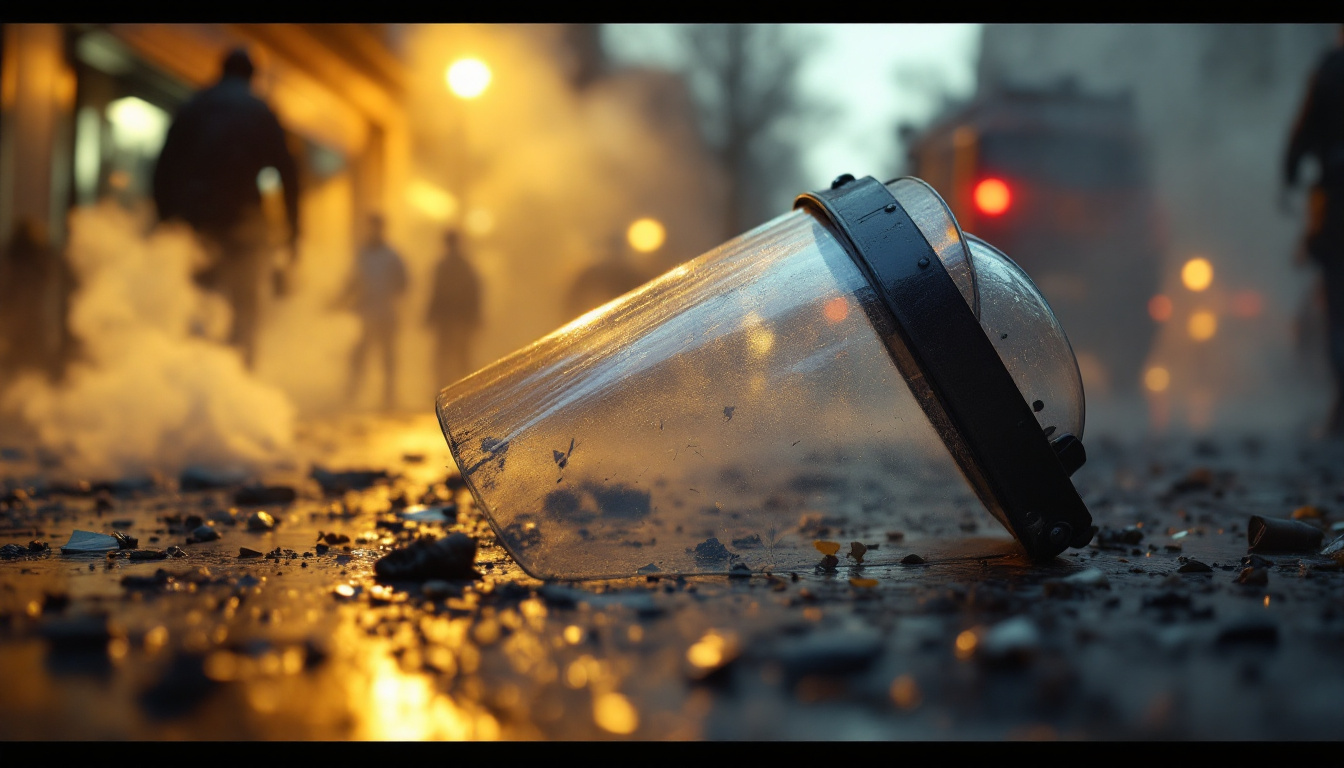
At 9:15 on a Friday morning in Belfort, a 59-year-old police commander, chief of territorial intelligence for the Territoire de Belfort, moved to arrest a young man near Lycée Gustave-Courbet. The young man had a bag with hydrochloric acid and protective gear in it.
The commander was in plain clothes. That didn't help him. A figure dressed in black knocked him to the ground, and a crowd of hooded, masked young people piled in, punching and kicking him in the face and head. He lost consciousness.
"A wild horde of young people," Belfort prosecutor Paul-Édouard Lallois called them. They "knocked him to the ground and beat him." He described it as "a scene of unheard-of violence" and added: "We came within two fingers of a tragedy."
The commander was taken to the hospital in Trévenans with multiple wounds to his face. Prosecutors have opened an attempted murder investigation, for a group attack on a public official. A 17-year-old student was taken into custody, though investigators haven't tied him to the blows. Two more people have since been detained.
The day before, in Paris, a trainee lieutenant with the police prefecture was sent in as reinforcement to a rowdy crowd of about a hundred outside a high school in the 20th arrondissement. She saw a police radio lying in the road and stopped to pick it up. That was enough to cut her off from her unit.
The crowd saw she was alone and came after her down Avenue Gambetta. Voices in the crowd shouted "Kill her" and called her a "bitch." She tripped, and they kicked her while she was on the ground, including in the head. She has filed a complaint.
Thursday's numbers show this is no small flare-up. Authorities arrested 1,949 people that day, and 305 police officers were injured. In schools, 235 people were hurt, including 65 school staff. School principals were assaulted in Normandy, Clermont-Ferrand and Pas-de-Calais. In Marseille, rioters went after firefighters and their trucks. On Friday, roughly 400 schools stayed closed. Since the end of September, about 5,000 people have been arrested, and 24 schools have been burned or ransacked.
So who are these mobs, and why now?
It started in late September at Lycée Saint-Exupéry in Créteil, a suburb in the ring of Paris banlieues where France's last two great riot waves began. Students staged a "blocus," barricading the school's entrance. Their complaints were teacher shortages, overcrowded classrooms and late buses.
A politician showed up on the very first day. Louis Boyard, a La France Insoumise member of parliament from the surrounding district, came to the school, posted videos with the students, and declared that "the student movement must be extended."
It was. Calls to action spread on TikTok, Snapchat and Instagram, some of them on leaflets made with AI tools. According to police intelligence, Snapchat and TikTok became the networks schools used to coordinate with each other. Within a week, blockades had spread to hundreds of schools across France, and the fires came with them.
The people under the hoods are mostly teenagers. Most of the roughly 5,000 arrested have been minors. Prosecutors haven't said how many are actually students at the schools they're "protesting." Even the official report on the Paris attack could not establish whether her attackers were students at all.
Prime Minister Sébastien Lecornu's office has been blunt. Citing French intelligence, it called the violence "urban violence" and "an organized maneuver by LFI and its ultra-left proxies."
LFI's leader isn't exactly backing away from it. Jean-Luc Mélenchon, the far left's likely 2027 presidential candidate, told his activists to "interpose" themselves between the students and the police. He has called on supporters to "organize to accompany" the movement, which he describes as "a point of departure" and a way of "opening a political outlet toward 2027." He even suggested parents show up to the next demonstration in white helmets.
LFI's national coordinator, Manuel Bompard, says the accusations are paranoid and told the government "to avoid descending into conspiracy thinking." Marine Le Pen sees it differently. She calls them "organized riots framed by La France insoumise deputies."
So the far left's presidential hopeful is treating the uprising as the start of his campaign while officers are being chased down in the streets.
The police see something worse than 2023. "The riots are worse than after the death of Nahel," one police union spokesman said. "We have never seen this." That summer, the police shooting of a 17-year-old in Nanterre set off a week of burning cars and looted stores across the country.
The Alliance police union said officers are being "hunted like prey, caught, thrown to the ground and struck in the face several times." Then it gave its verdict in capital letters: "This is no longer anti-cop hatred. IT IS A HUNT FOR COPS."
Interior Minister Laurent Nuñez called the attacks "rare" and "unbearable," and said they were "deliberately targeted." He promised that "everything will be done to identify the authors of this abject act." He sent the BRAV-M motorcycle units into Paris and ordered officers to use force against "rioters." Education Minister Édouard Geffray says the student movement has been "taken hostage by ultraviolent groups."
Le Pen called the image of the young Paris officer, "pursued by a pack howling its hatred, thrown to the ground and assaulted," unbearable, and demanded "exemplary sentences." Éric Zemmour went further: "These are ethnic riots and demographics is destiny."
For a generation, France's political class has followed the same script after every riot wave, in 2005 and again in 2023: condemn the violence, promise an investigation, call it a social problem, and change nothing. The 2005 riots started in the Paris banlieues. So did the 2023 riots, and so did this one.
This time, the government has at least said out loud who it thinks lit the match. The match is still burning.
The student unions are calling for "Act III" on Tuesday. Police intelligence is warning that the black blocs may show up.