
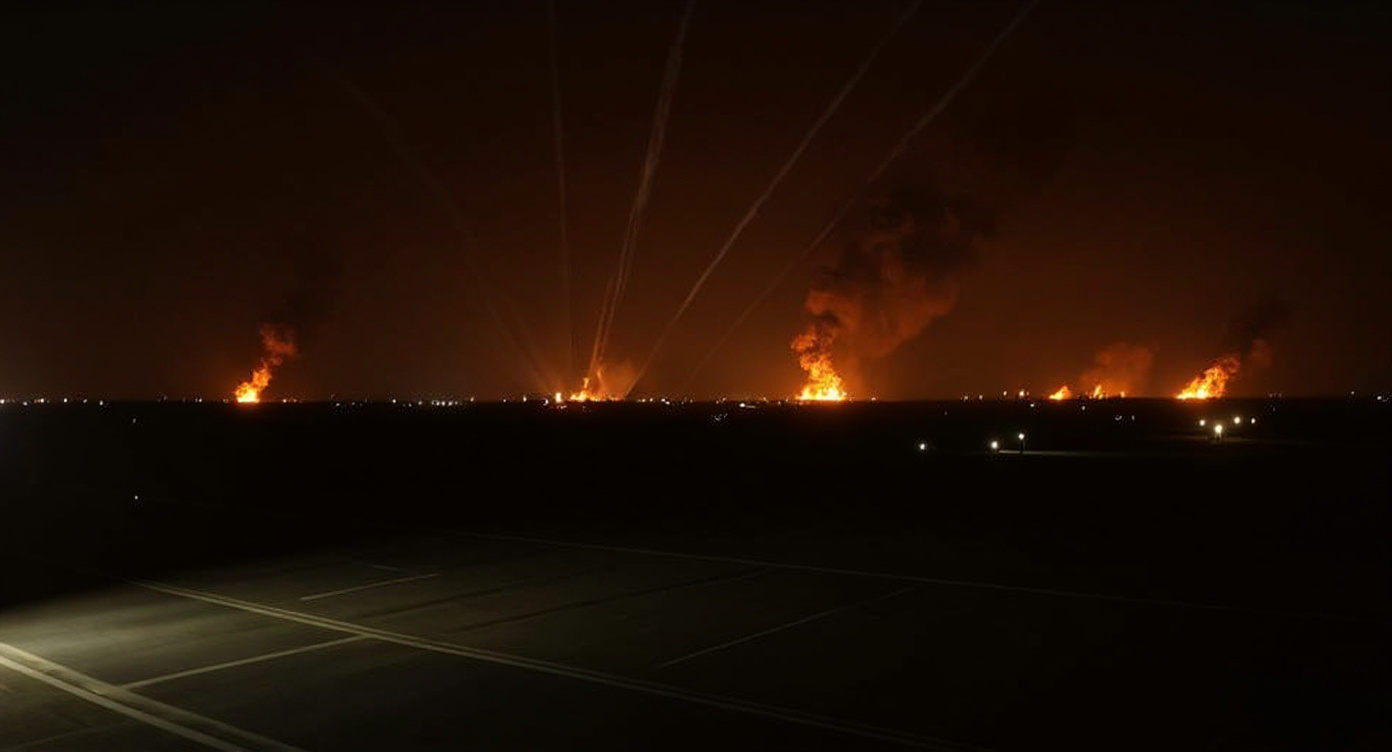
Iran fired 3 missiles at Kuwait's Ali al-Salem airbase — a U.S. military installation in an allied nation — while simultaneously lobbing drones and ballistic missiles at targets across Saudi Arabia, the UAE, and Bahrain. Explosions and air raid sirens lit up the Persian Gulf. And President Trump says a deal could come "over the next week." Sure. Iran's just softening up the negotiating table. With cruise missiles.
Bold strategy, Tehran.
This all kicked off after the U.S. launched a nighttime strike on Iran's Qeshm Island, and Iran decided to respond by turning the entire Gulf into a shooting gallery. Kuwait reported its air defenses intercepted incoming fire, but people were still wounded. The IRGC — Iran's Islamic Revolutionary Guard Corps — put out a statement claiming they conducted "precise and intensive missile strikes" on U.S. bases, and warned that any further American aggression would face a "seismic, crushing, and decisive response." That's a lot of adjectives for a country whose economy runs on selling oil nobody wants to buy at gunpoint.
Secretary of State Marco Rubio testified before the Senate Foreign Relations Committee and offered the most honest assessment anyone in Washington has given in months. "Iranian people would make a deal tomorrow if it were up to them," Rubio said. "The Supreme Leader and the IRGC are a bit more immune to pressures." No kidding. The IRGC doesn't care about sanctions or diplomacy — they care about projecting power and staying in control. Rubio gets it.
Senator Ted Cruz pressed Rubio on whether regime change should be on the table. That's the question nobody in polite Washington wants to answer, but it's the only one that matters when you're dealing with a theocratic regime that responds to peace overtures by shooting missiles at airports.
Meanwhile, the U.S. isn't sitting still. American forces disabled a non-compliant vessel and hit an oil tanker with a Hellfire missile in what's shaping up to be an increasingly hot conflict around the Strait of Hormuz. Oil prices spiked. Markets rattled. The 95-day conflict shows zero signs of cooling off.
President Trump posted that "the conversations between us have been going on continuously" and urged Iran directly: "It's time for you to make a Deal." We all want a deal, Mr. President. But Iran's version of continuous conversation involves drone swarms and ballistic missiles. Their deputy foreign minister, Kazem Gharibabadi, accused the U.S. of "direct role in managing the Zionist regime's aggressions" — which is Iranian for "we're not making a deal, and also, everything is your fault."
The situation in the broader region is pure chaos. Israeli Prime Minister Benjamin Netanyahu warned that if Hezbollah "does not stop attacking our cities and civilians," strikes will continue. Twenty-six Israeli soldiers have been killed since fighting escalated 3 months ago, along with 4 Israeli civilians. Southern Lebanese towns — Nabatieh, Tyre, Marwaniyah — are getting hammered by Israeli air raids. The so-called ceasefire is holding the way a wet paper bag holds groceries.
As ZeroHedge reported, Iran's state media outlet Fars claimed communications between Tehran and Washington have stalled for "at least a few days." So we've got active missile strikes on allied nations, a naval confrontation in the most critical oil chokepoint on earth, and both sides saying talks are either imminent or dead depending on which statement you read.
Here's the bottom line: you don't negotiate with a regime that fires missiles at your allies' airports and then calls it self-defense. Iran isn't interested in a deal. They're interested in surviving long enough for the West to lose interest. We shouldn't oblige them.