
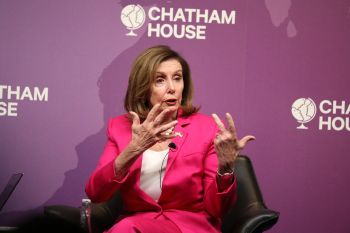
After nearly 40 years representing San Francisco in Congress, Nancy Pelosi announced that she's retiring from elected office. She also announced what comes next: a $35 million institute bearing her name at the University of California, Berkeley, where she'll co-teach a course on Congress and pursue an agenda of climate policy, wealth redistribution, and electoral reform.
Retiring from Congress isn't the same thing as retiring from politics. Pelosi, 86, has simply moved her operation off the House floor and onto a college campus. The agenda is identical. The audience is younger and easier to shape.
The Nancy Pelosi Institute for Representative Democracy is scheduled to open in January 2027 — roughly two months after she leaves office. Thirty-five million dollars in philanthropic commitments have already arrived from donors the announcement declines to name. For an institute dedicated to "strengthening democratic institutions," the funding is conspicuously opaque.
"I am honored to partner with this exceptional community of scholars and students so we can equip the next generation with the tools they need to strengthen our democratic institutions and forge a future that serves the public good," Pelosi said in her announcement.
That sounds lovely. It also sounds exactly like a Democratic Party fundraising email.
The institute has four stated pillars: strengthening America's democratic institutions, overcoming "societal, economic, and planetary challenges," promoting human and civil rights, and ensuring political leadership represents "diverse perspectives and backgrounds." The research agenda includes climate change solutions, wealth inequality, and electoral changes designed to reduce voter polarization.
Climate change. Wealth inequality. Electoral reform. If you closed your eyes, you'd think you were reading the 2024 Democratic platform. But slap "institute" on it and suddenly it's nonpartisan academic inquiry.
UC Berkeley Chancellor Rich Lyons made the mission explicit: "We intend to do more than simply study democracy. We are building this institute to strengthen it."
Building it. Not studying it. Not analyzing it. Building it — according to the vision of a woman who spent four decades as one of the most partisan legislators in American history. That's not an academic mission statement. That's an operational one. Pelosi isn't leaving partisan politics behind. She's giving it an endowment and a syllabus.
The record she's bringing into the classroom doesn't exactly scream democratic pluralism. The ACA passed on a party-line vote. Both impeachments were party-line exercises that ended in Senate acquittal. She ripped up a sitting president's State of the Union address on live television. Her signature achievements were products of raw political muscle, not bipartisan consensus-building. That's the expertise she's now packaging as a course on how Congress works.
Then there's the money. Thirty-five million dollars has already materialized from unnamed donors — tax-advantaged philanthropic commitments flowing into an entity named after an active political figure who hasn't even left office yet. Berkeley is a public university. The institute dedicated to transparency in democratic institutions won't say who's funding it.
The location tells you everything the mission statement won't. This isn't Stanford. It isn't a nonpartisan think tank in Washington. It's UC Berkeley — a campus where conservative speakers need security details and where the political center of gravity makes San Francisco look like a swing district. An institute for "representative democracy" planted in one of the least ideologically representative ZIP codes in America.
Pelosi spent nearly 40 years accumulating power through favors, fundraising, and an iron grip on her caucus. The institute bearing her name will run the same play — recruit students already primed toward progressive politics, hand them the vocabulary of democratic reform, wire them into donor networks built over four decades, and send them into government, media, and academia.
That's not retirement. That's succession planning.
When the chancellor says they're not just studying democracy but building it, and the curriculum covers climate policy and electoral reform, and $35 million arrives from unnamed donors, you're not looking at an academic institution.
You're looking at a farm system.