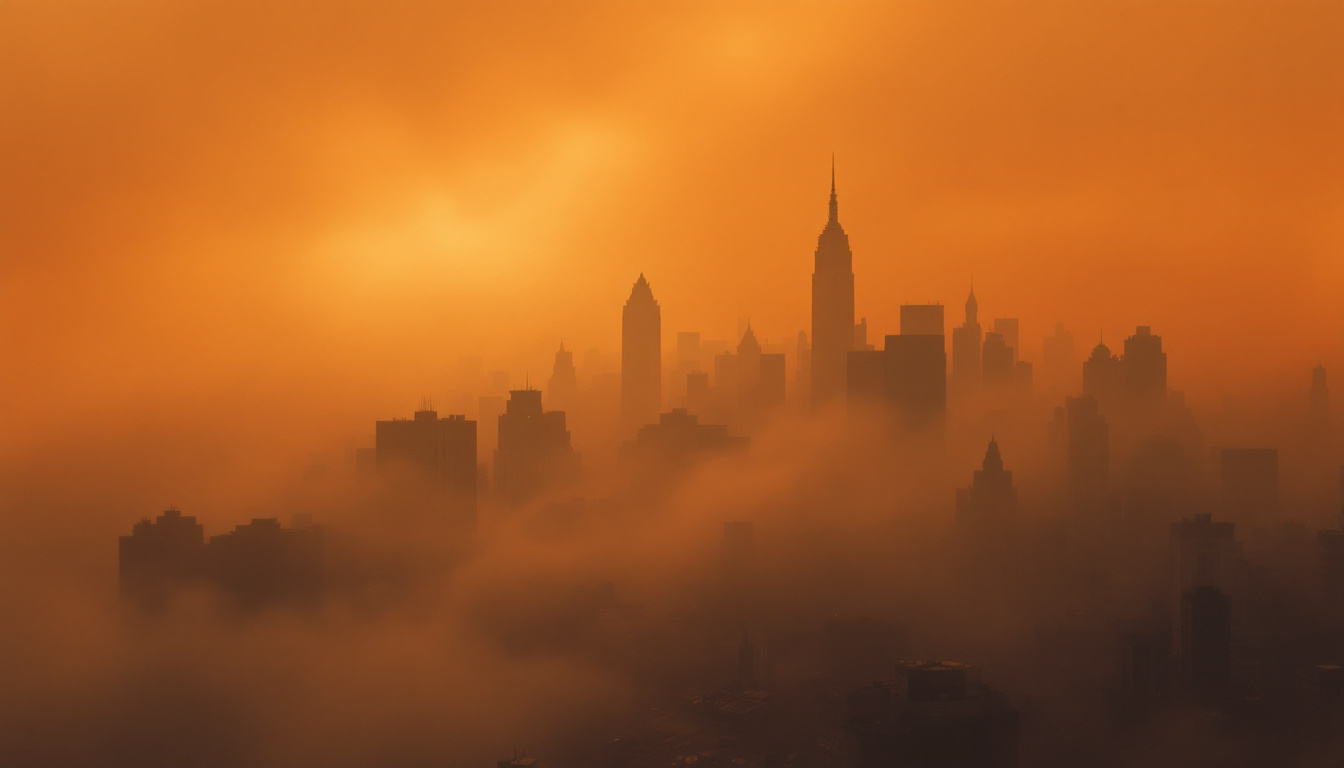
The Air Quality Index in New York City is forecast to hit 200 on Thursday — a level the federal government classifies as "unhealthy" for everyone, not just the elderly or asthmatic. For context, Delhi, India — the city environmentalists have spent decades pointing to as the poster child for unbreathable air — routinely sits around 150 to 180 this time of year.
New York is about to out-pollute Delhi. Let that competition sink in for a state that has banned gas stoves.
The culprit is Canadian wildfire smoke, which has been thickening over the tristate area since Tuesday and is expected to linger through the end of the week, according to the National Weather Service. Governor Kathy Hochul issued a statewide Air Quality Health Advisory on July 15 after more than 50 monitoring stations across New York began registering PM2.5 — fine particulate matter, the kind that lodges deep in your lungs — well above safe levels. The advisory threshold is an AQI above 101. New York is nearly doubling it.
"Distant wildfires have impacted New York State in recent years, and this week unfortunately will be no different with expected hazy skies and poor air quality," Hochul said from Albany. Which is one way to describe a recurring emergency your government has done precisely nothing to prevent.
This isn't the first time. In June 2023, New York's AQI peaked at 480 — so far off the "hazardous" charts that health officials essentially told residents to seal themselves indoors. Three years later, the same Canadian wildfire smoke is rolling south through the same atmospheric corridors, choking the same city, and the official response is identical: stay inside, limit strenuous activity, and here's a mask.
The NYPD, NYC Public Library branches, and the FDNY are distributing KN95 and N95 masks to residents. Mayor Zohran Mamdani's administration has activated cooling centers within a 10-minute walk of most neighborhoods, with temperatures expected to hit the low 90s to near 100°F — compounding the respiratory danger with heat stress.
Dr. James McDonald, the State Health Commissioner, offered the sort of guidance that could have been copied and pasted from the 2023 playbook: "People who are especially sensitive should avoid spending time outdoors, if possible." The NWS was slightly more direct, noting that "Canadian wildfire smoke continues to thicken over the area into tonight, likely lingering into the end of the week." Improvement isn't expected until Friday at the earliest, with forecasters predicting a possible round of "dirty rain" on Saturday — precipitation filtering smoke particulates out of the atmosphere and depositing them on everything below.
New York has spent the last decade positioning itself as America's climate capital. The state passed the Climate Leadership and Community Protection Act. It has committed to an 85% reduction in greenhouse gas emissions by 2050. It has regulated gas hookups in new buildings. It has subsidized electric vehicles. It has lectured Texas, Ohio, and every red state in between about environmental responsibility.
And none of it — not one provision, not one regulation, not one dollar — addresses the wildfire smoke that has now choked the city in two of the last four summers. The emissions New York is reducing are not the emissions filling its skies. The fires are in Canada. The smoke is carried by weather patterns no state law can regulate. The only actual defense is the same one available to every state that hasn't spent a dime on climate legislation: close your windows and put on a mask.
New York's climate framework was built to fight a theoretical future catastrophe. The actual, recurring, breathable catastrophe keeps arriving every July, and the response is a press release and a box of N95s.
When your air quality is worse than the city you've been using as a cautionary tale, the cautionary tale might be you.