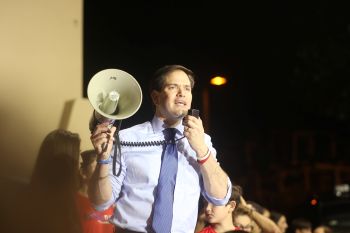
Secretary of State Marco Rubio has invited senior officials from more than 60 countries to the State Department on July 16 for a summit on far-left terrorism. The concept paper circulated to foreign governments describes the focus as "far-left terrorists" engaged in "organized, deadly violence to advance their political objectives."
So naturally, the experts are panicking.
White House counterterrorism adviser Sebastian Gorka has been exploring whether foreign terrorist designations — the same tools we use against jihadist networks — could apply to antifa-linked groups operating across borders. The summit will bring together ministers from across Europe, Latin America, and Asia, including India, Indonesia, and Singapore, to discuss intelligence sharing and law enforcement cooperation against politically motivated far-left violence.
This isn't theoretical. Members of what prosecutors described as an "antifa cell" received lengthy prison sentences last month for a violent protest outside an ICE facility in Texas where a police officer was shot. President Trump signed an executive order designating antifa a "domestic terrorist organization." The administration is now asking whether the international tentacles of these groups warrant the same treatment we give al-Qaeda affiliates.
The reaction from the credentialed class has been predictable. Colin P. Clarke, Executive Director of the Soufan Center, told Newsmax, "If I were to rack and stack priorities, left-wing terrorists wouldn't be in my top three." Bruce Hoffman, Senior Fellow for Counterterrorism at the Council on Foreign Relations, argued, "We have to be objective about identifying threats, not politically selective."
Interesting framing from people who spent the last five years insisting the only domestic terrorism worth discussing involved red hats and trespassing charges.
One current administration official — anonymous, of course — raised the concern that designating far-left groups sets "a precedent for a future Gavin Newsom administration to turn these authorities on conservatives." That's the argument: we shouldn't enforce laws against actual violent actors because a hypothetical future Democrat might abuse the same tools.
The White House pushed back directly. The administration's national counterterrorism strategy, released in May, states plainly: "We will not permit the weaponization of America's unparalleled CT capabilities for partisan purposes." It adds: "Our counterterrorism powers will not be used to target our fellow Americans who simply disagree with us."
That's a remarkable sentence to have to write. It's also a remarkable sentence to need to write — because the previous administration did exactly what this one is promising not to do. Parents at school board meetings became domestic threat referrals. Traditional Catholics got flagged by the FBI. The "weaponization" these critics fear already happened. It just pointed in the other direction.
What Rubio is doing here is straightforward. A cop got shot at a protest organized by people who share ideology, tactics, and sometimes personnel with groups operating in Germany, Greece, and across Latin America. The question of whether that network deserves the same international law enforcement attention as right-wing militias or Islamist cells isn't radical. It's the baseline of taking political violence seriously regardless of which flag it waves.
The critics aren't really arguing that far-left violence doesn't exist. They're arguing it doesn't count the same way. Clarke's quote is the tell — it's not a denial, it's a ranking. The violence is real, the prison sentences are real, the shot cop is real. It just doesn't make his top three.
Sixty countries will be in Washington next week to discuss it anyway. Apparently it makes someone's top three.