
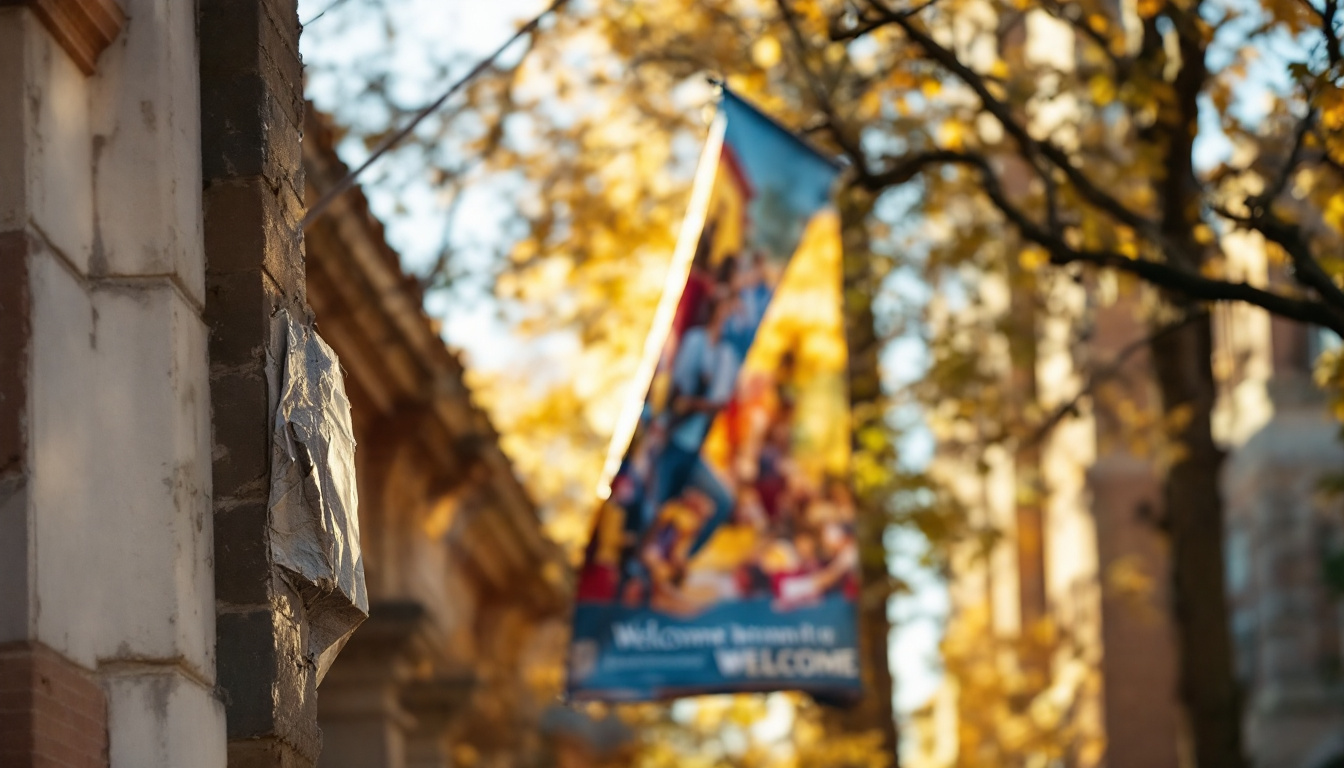
Billy Ramirez was driving back to campus from his hometown when a friend texted him a side-by-side photo comparison. On the left, the original picture — Ramirez, a Hispanic man, posing with two classmates at a 2025 Lunar New Year party in front of Star Ginger, Stanford's dining hall. On the right, the same photo on a welcome banner hanging on campus, except Ramirez was gone. In his place stood an AI-generated Black woman who has never existed.
The two other students in the photo had been digitally slimmed down to appear more attractive. Ramirez had been digitally erased.
Stanford Residential & Dining Enterprises — the department responsible for campus dining promotions — took the original photograph, ran it through AI tools, swapped a real Hispanic student for a fictitious Black female, thinned out the remaining students, and hung the result on welcome banners across campus. The Stanford Review, an independent conservative student paper, published the side-by-side comparison on September 21, and the images went viral on X within hours.
"At first, I found it hilarious that they had used AI to completely change our appearances, including my race and gender," Ramirez told PetaPixel. The humor didn't last. "But after looking at the comparison, I was also upset because I don't agree with Stanford making those choices about how we were represented. Seeing my identity changed and being left out of the picture made me feel, in a way, silenced and erased from a representation that was supposed to include me."
Stanford spokesperson Charlene Gage issued a statement that read like a form letter from a compliance office that just got caught. "Stanford's AI policy is clear: The use of AI in producing or altering images of Stanford people, events, research, facilities, or achievements is strictly prohibited," Gage said. "Both the alteration and lack of disclosure in this case violate that policy. We are working to provide additional training for all staff and ensure proper review of all materials."
Additional training. That's the institutional fix for fabricating a human being to meet a diversity quota. Someone in a university department looked at a photograph of three real students and decided what was missing wasn't better lighting or a different angle — it was a different race. Then they used AI to manufacture one. And the penalty is a staff seminar.
Check out the before and after photos Stanford digitally altered
The university pulled the banners. That much they managed. But the response tells you everything about how the DEI apparatus actually functions at elite institutions. The policy already existed. The prohibition was already "clear," per Gage's own words. A staffer broke it anyway, because the photo didn't have the right racial composition, and nobody in the review chain caught it — or cared.
Tyler Harper, a staff writer at The Atlantic, put it plainly: "What better distillation of higher education in the 2020s than a bureaucrat using AI to fake-diversify an elite campus."
This isn't even a new play. In 2000, the University of Wisconsin-Madison got caught editing a Black student's face into a crowd photo on the cover of an application booklet. The student had never attended the event in the photo. Wisconsin had to reprint 100,000 brochures. That was 26 years ago, and the method was Photoshop. Stanford's version is the same instinct with better software.
The pattern is worth noticing. The university didn't recruit more Black students. Didn't photograph the ones already there. Didn't rethink whether a dining hall promo banner needed to function as a census report. The machine that exists to celebrate diversity looked at a real Latino student and decided he was the wrong kind of diverse. So it deleted him and generated something more useful.
Ramirez said he was "immediately baffled" when he first saw the comparison. He'd been swapped out of his own photograph at his own school — not because the image was flawed, but because his face wasn't the face the institution wanted to project.
Stanford's endowment is north of $36 billion. They spent it on AI to invent a student.