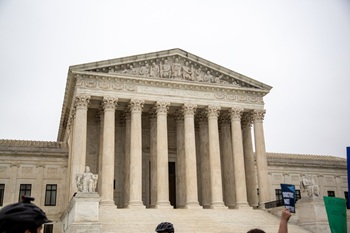
The US Supreme Court issued an opinion on Wednesday that is being hailed as a landmark victory for election integrity. In a 7-2 ruling, the court declared that political candidates have a vested interest in the outcome of election rules. Therefore, candidates have legal standing to challenge the outcome if something wonky happens during the counting of votes. Chief Justice John Roberts authored the opinion.
That’s odd. Why did Justice Roberts have the exact opposite opinion in 2020, when the candidate challenging the wonky election results was Donald Trump?
The case that the court ruled on this week was Bost v. Illinois State Board of Elections. The court ruled that Congressman Mike Bost (R-IL) has legal standing to challenge Illinois’ ridiculous law that allows mail-in ballots to be counted up to 14 days after Election Day. The lower courts had rejected Rep. Bost’s case, using what we might think of as the “Trump standard.”
They ruled that Bost lacked standing to sue. Sounds… vaguely familiar, doesn’t it?
Justice Roberts wrote the following in the majority ruling:
“He [Bost] is a candidate for office. And a candidate has a personal stake in the rules that govern the counting of votes in his election.
“An unlawful election rule can injure a candidate in several ways. It might cause him to lose the election. It might require him to expend additional resources. Or it might decrease his vote share and damage his reputation. Respondents concede that each of these harms can be legally cognizable… Candidates also have an interest in a fair process. Candidates are not common competitors in the economic marketplace. They seek to represent the people.”
Now, wait just a cotton-pickin’ minute!
Some of us remember the fake and stolen 2020 election quite well. That was NOT the legal opinion that John Roberts had in November of 2020.
You’ve probably heard this lie repeated many times by the fake news media: “Donald Trump lost 60 election cases. The courts found no evidence of election fraud.”
Donald Trump won the first three election fraud cases that his lawyers brought that month. This caused the entire Judicial system in America to collectively crap their pants. After that, a new standard went out: In any state where Donald Trump or his supporters challenged obvious election fraud, they declared that he “lacked standing” to sue.
Trump won the first three cases, and the courts ruled that the plaintiffs lacked standing in the next 57. This meant that judges were excused from even looking at the obvious evidence of fraud.
Here is the list of people who were declared to “lack standing” to challenge suspected election fraud in November 2020:
Donald Trump (the candidate); Donald Trump’s personal attorneys; the Trump Campaign’s attorneys; Texas Attorney General Ken Paxton (who sued Pennsylvania); US Attorneys working for the Department of Justice; public interest legal firms like Judicial Watch; state-level election integrity groups; and patriotic voters.
NO ONE had standing to take suspected election fraud to court!
Many of those groups and attorneys petitioned the Supreme Court for an emergency ruling in November 2020. If no one has standing to challenge a fraudulent election, then is it okay to just steal every election? Was that the standard?
The Supreme Court met privately in chambers to decide whether to issue a ruling. Initially, Justices Clarence Thomas, Samuel Alito, Neil Gorsuch, Brett Kavanaugh, and Amy Coney Barrett were in agreement. The Supreme Court needed to intervene. Even the head of the Federal Election Commission had publicly declared, by that point, that the 2020 election had been stolen right in front of the American people.
People who were outside the private meeting could hear John Roberts screaming through the door. He literally screamed at the other judges. He claimed that there would be “riots in the streets” if the high court intervened on behalf of candidate Donald Trump.
Justices Brett Kavanaugh and Amy Coney Barrett turned out to be moral cowards. They sided with John Roberts and the three liberal justices, and the Supreme Court decided to let the “Trump standard” stand. No one had standing to sue over election fraud.
Now that Donald Trump has no more elections that can be stolen from him, we’re going back to the old standard. Candidates once again have a vested interest in the outcomes of elections, and they have legal standing to challenge results. I guess that’s something.