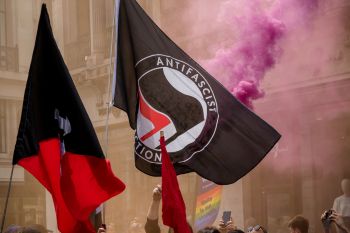
Benjamin Song, identified as the leader of the North Texas Antifa Cell, is serving 100 years in federal prison. Maricela Rueda got 70. Savanna Batten, Zachary Evetts, Autumn Hill, Meagan Morris, and Elizabeth Soto each drew 50. Daniel Rolando Sanchez-Estrada received 30. Nine people, convicted by a federal jury on domestic terrorism charges — rioting, use of weapons and explosives, providing material support to terrorists, obstruction, and attempted murder.
One year ago, we were told the designation that produced those convictions was unconstitutional theater.
On September 22, 2025, President Trump designated Antifa a domestic terrorist organization. The announcement came less than a week after the assassination of conservative activist Charlie Kirk, amid a surge of left-wing political violence that the usual gatekeepers spent years pretending didn't exist. Trump was blunt about the reasoning: "These aren't protests. These are crimes."
The North Texas cell's rap sheet proved the point. Members were charged in connection with a July 4, 2025 attack on a Customs and Border Patrol helicopter and an assault on an Alvarado police officer near the Prairieland ICE Detention Center. The group brought weapons and explosives to a federal facility and attempted to murder the officers inside. Call that a protest if you want.
The domestic designation was phase one. By November, Secretary of State Marco Rubio had designated four European-based Antifa-affiliated organizations as foreign terrorist organizations, including Italy's Autistici/Inventai collective, which provided digital infrastructure to cells worldwide. Portland's Rose City Antifa — the group that spent years openly organizing street violence while local prosecutors looked the other way — found itself named in federal targeting documents. The State Department indicated more designations would follow as the administration continued to "identify and disrupt Antifa's terror networks across the world."
Rubio convened a ministerial session with representatives from over 60 countries in July 2026, and his message carried zero ambiguity. "You are here because this is real and it is getting worse, and it can no longer be denied," he told assembled diplomats.
The response from allied governments came within days of Trump's announcement. The Dutch parliament passed a motion — introduced by Geert Wilders and a coalition of conservative parties — calling for the Netherlands to formally designate Antifa as a terrorist organization. Their stated rationale: "Antifa cells are also active in our country, threatening politicians, disrupting meetings, intimidating students and journalists, and not shying away from using violence." Hungarian Prime Minister Viktor Orbán skipped the motion stage entirely. Hungary had its own Antifa incident on record: a 2023 attack in Budapest in which Antifa activists assaulted participants at a far-right event, resulting in the arrest and year-long imprisonment of Italian activist Ilaria Salis. On September 26, 2025, Orbán's government issued an official decree making Hungary the first European nation to formally list Antifa as a terrorist organization. "We will follow the American model," he said. In the European Parliament, a draft resolution backed by 79 members from 20 countries called for an EU-wide designation. The designation Washington was told was unconstitutional theater had become an international template within a week.
Treasury Secretary Scott Bessent opened a second front. "We are examining where tax-exempt status has been exploited," Bessent said, referencing investigations into nonprofit funding pipelines that fueled Antifa operations. The $80 million that George Soros's foundations funneled to groups linked to extremist networks is now the subject of active federal financial review.
The critics who screamed "fascism" when the designation was announced operated on the assumption that it would be symbolic — a press conference, a news cycle, then nothing. That's how Washington usually works. What they misjudged was whether this administration intended to actually use the tools the designation unlocked. Federal prosecutors did. The State Department did. Treasury did.
Trump was asked before he signed the designation whether he'd follow through. "I would do that 100%," he said.
Nine convictions. Sentences ranging from 30 to 100 years. Four foreign organizations designated. Financial networks under federal audit. Sixty countries at the table. Hungary with a formal decree on the books. Seventy-nine European parliamentarians pushing for continent-wide action.
He did it 100%.