
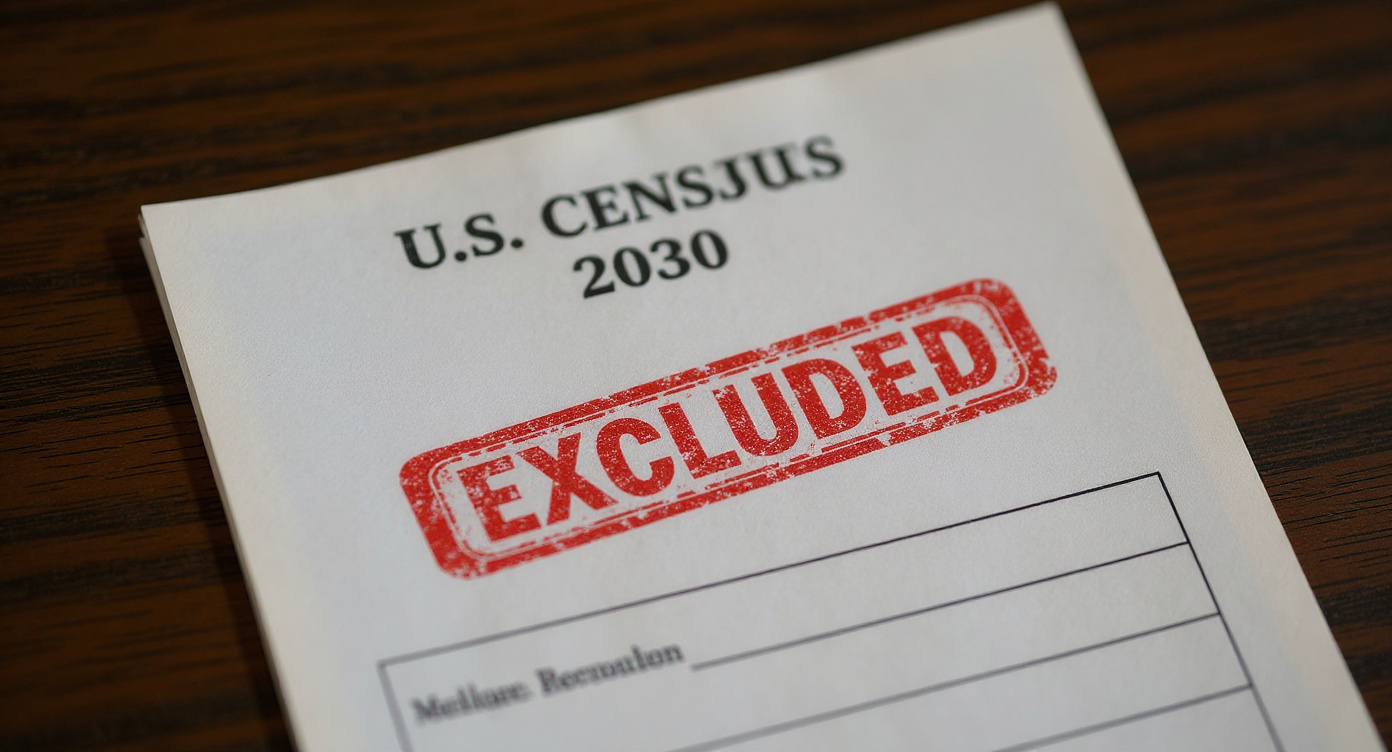
The Department of Commerce just published a proposed federal rule that would exclude illegal aliens and foreign visitors from the 2030 Census apportionment count. The rule cites 13 U.S.C. 141 and the Supreme Court's ruling in Franklin v. Massachusetts as legal authority — and if it survives the inevitable lawsuits, it would directly reduce the number of congressional seats awarded to states that have spent decades importing their voter base.
California should probably start measuring the drapes for a smaller delegation.
The proposed rule states that "illegal aliens (among others) should not be included in the apportionment count, as they are not true inhabitants, members of the body politic, or persons with a 'usual residence' in the United States due to their lack of a sufficient tie and allegiance to the United States." That's the Census Bureau — not a conservative think tank, not a cable news pundit — putting into regulatory language what most Americans assumed was already the case.
The rule goes further, asserting that "excluding illegal aliens (among others) from the apportionment count is a lawful and appropriate exercise of the Census Bureau's discretion." In other words, this isn't a constitutional crisis. It's a paperwork correction that's about forty years overdue.
Here's the part that makes the mechanism clear. Research from the Center for Immigration Studies found in 2024 that each single percentage point increase in the foreign-born share of a congressional district's population was associated with a 1.8 percentage point increase in Democrat vote share. The researchers were careful to note: "This is not evidence of non-citizens voting." It doesn't need to be. The scam was never about non-citizens casting ballots. It was about non-citizens being counted as bodies in a district so that the citizens who do vote — overwhelmingly Democrat in those areas — get outsized representation in Congress.
Think about that for a second. A district in Texas with 700,000 citizens gets one House seat. A district in Los Angeles with 500,000 citizens and 200,000 illegal aliens also gets one House seat. Same representation, fewer actual voters. The citizens in that LA district have more voting power per person than the Texans — and the people inflating their count can't even legally be in the country.
As CIS put it, "the voters who live around non-citizens tend to be Democrats, who end up having more voting power due to the presence of a large number of non-citizens." That's not a bug in the system. For Democrats, it was the entire product.
The opposition's argument writes itself: the Constitution says "persons," not "citizens." The Fourteenth Amendment doesn't distinguish. And that framing might have carried weight in 1868, when the country wasn't managing a population of millions of people who crossed the border illegally and were never supposed to be here in the first place. The Census Bureau's own proposed rule addresses this directly — "usual residence" and "sufficient tie and allegiance" are discretionary determinations, and the Bureau is exercising that discretion now.
This is the quiet mechanism behind decades of blue-state power inflation. Every ten years, the census counts heads. Those heads determine how many House seats — and therefore how many Electoral College votes — each state gets. States with large illegal alien populations have been receiving bonus representation funded by people who have no legal right to be here. The incentive structure practically begged for open borders.
The policy push lands at a moment when the border debate has shifted from "should we secure it" to "how do we undo the damage from when we didn't."
President Trump tried a version of this during his first term and got blocked. The legal landscape has shifted since then, and the administration clearly believes the regulatory path through the Commerce Department can hold. Whether the courts agree is another question — but the underlying math isn't going anywhere. When you stop counting people who aren't supposed to be here, some states get smaller delegations. Those states happen to be blue.
Funny how that works.