
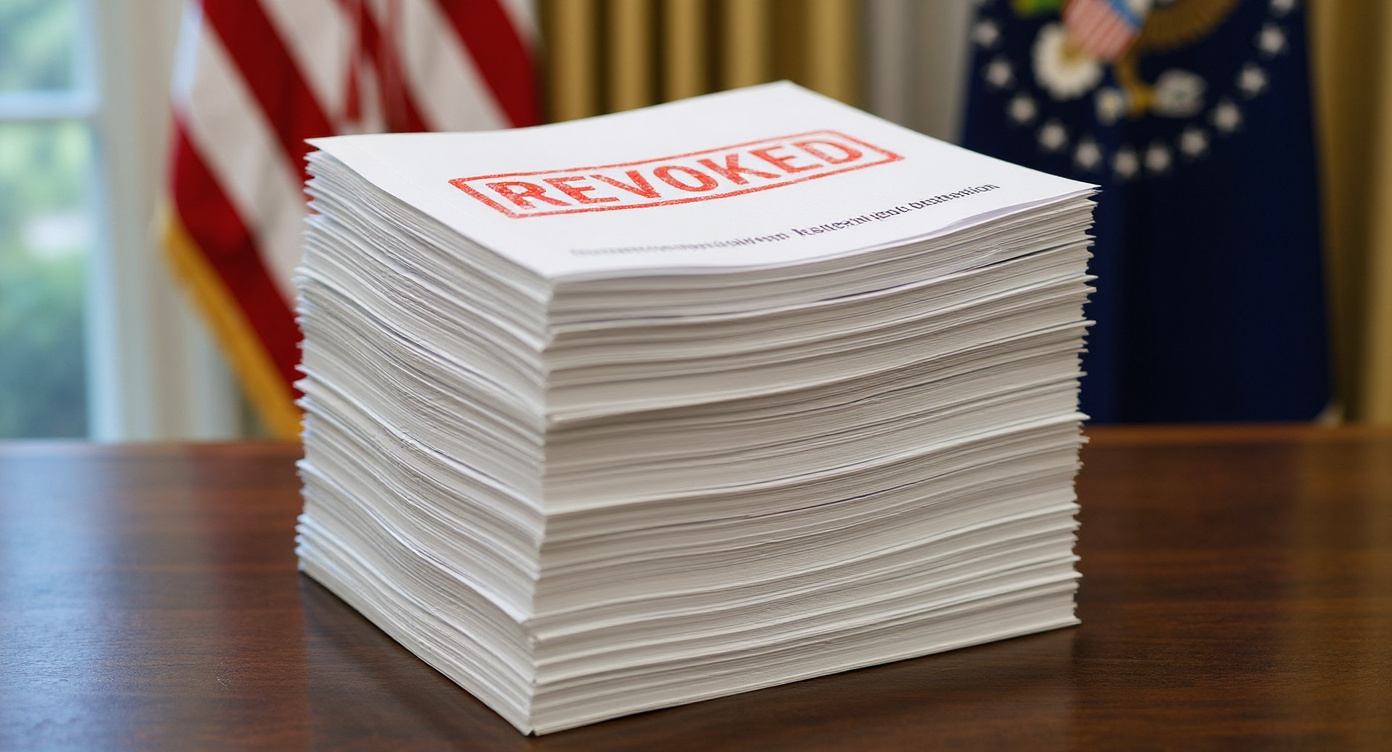
Somewhere in Washington, there is a federal regulation governing the acceptable curvature of bananas sold in school cafeterias. We don't know its number. We don't know which GS-14 wrote it. But we know it exists, because when your government has piled up enough rules to cost the economy $1.5 trillion in a single fiscal year, the banana rule is a statistical certainty.
The Trump administration just published its plan to kill 702 of these things.
The Office of Information and Regulatory Affairs — OIRA, for those keeping score — released the fiscal 2026 deregulatory agenda on July 6, targeting 702 federal regulations for elimination or revision across multiple agencies. Mark Paoletta, the General Counsel performing duties of OIRA Administrator, said the effort is aimed at "promoting economic growth, jobs, and affordability." The OIRA introduction document put it more bluntly: the goal is to "put America and Americans first."
This isn't year one enthusiasm, either. The 2025 deregulatory plan targeted 482 actions. The administration reported $211.8 billion in cost savings from that round alone. Now they're scaling up — 702 actions, with the $1.5 trillion figure representing the total regulatory burden they're working to dismantle.
The biggest single target is the Obama-era Endangerment Finding, the regulatory keystone that allowed the EPA to treat carbon dioxide as a pollutant and layer climate rules across the entire economy. Revoking it accounts for $1.3 trillion of the $1.5 trillion total. That one finding — issued by unelected bureaucrats at the EPA — has been the legal justification for everything from power plant shutdowns to the war on gas stoves.
The remaining actions span agencies like a regulatory yard sale. The EPA is reconsidering Biden-era pollution standards for light- and medium-duty vehicles, a move projected to save consumers an average of $2,400 per new car, SUV, and truck. The USDA is proposing changes to school meal nutrition standards. The Labor Department is rethinking rules on independent contractors and retirement investment advice.
Each of these regulations was written by someone who never had to meet a payroll, never had to price a product, and never had to explain to a customer why the thing they wanted costs 15 percent more because of a compliance requirement buried in the Federal Register.
Critics will argue that regulations exist for a reason — that the Endangerment Finding protects public health, that vehicle emission standards clean the air, that nutrition rules keep kids healthy. Some of that is true in theory. But $1.5 trillion is not a theoretical number. That's money pulled out of the economy by rules that, in many cases, duplicated existing state regulations, solved problems that didn't exist, or imposed costs wildly disproportionate to their benefits. The $2,400 per vehicle figure alone tells you how much "protection" was being passed along to consumers as a hidden tax.
The pattern here is worth noting. The 2025 plan hit 482 targets and delivered $211.8 billion in measurable savings. The 2026 plan scales to 702 targets. The administration isn't just cutting — it's building a repeatable process for identifying and eliminating regulatory drag, agency by agency, rule by rule.
Seven hundred and two rules. Each one had a sponsor, a comment period, a Federal Register entry, and a compliance office. None of them had a line item on your ballot.
That $1.5 trillion was never a budget. It was an invoice nobody voted to approve.