
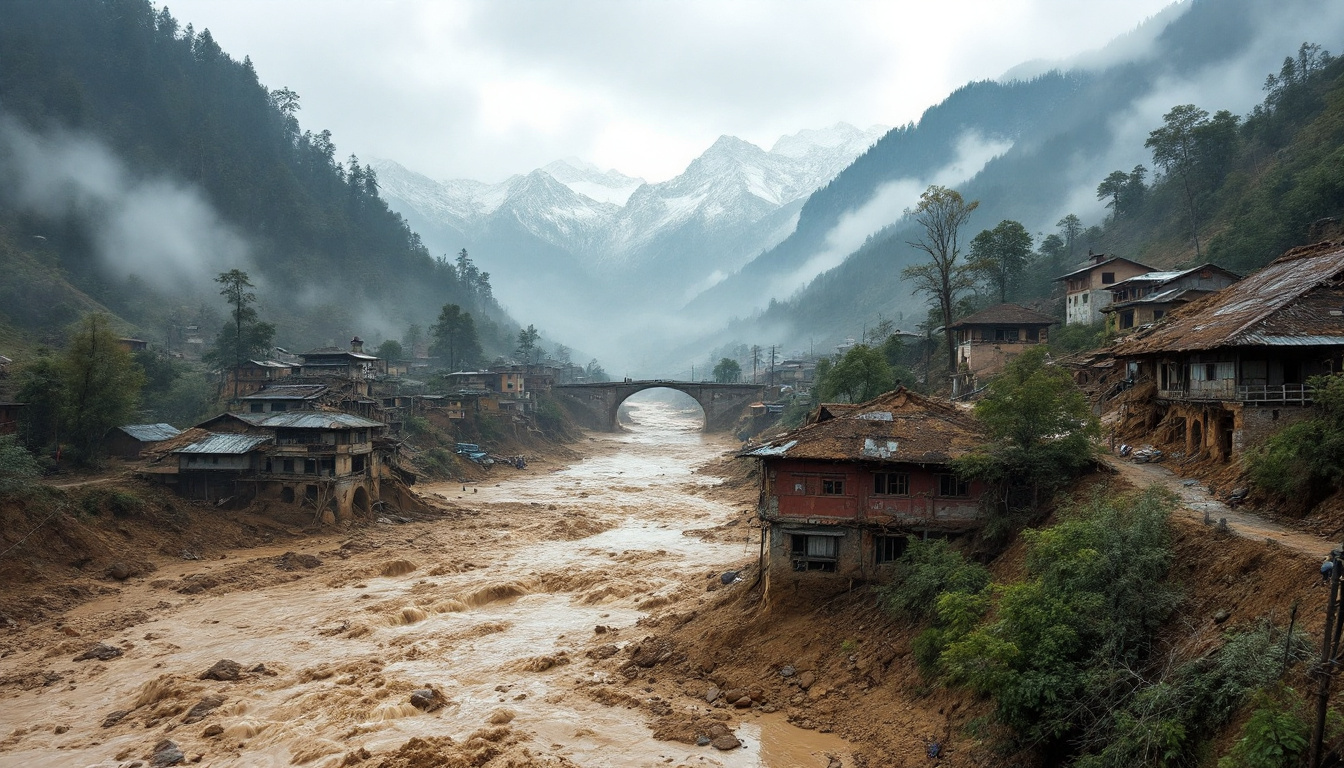
A 4.4 magnitude earthquake rattled the Nepal-China border region on Monday, and roughly seven minutes later, an ice-rock avalanche collapsed into the Lhende Khola river, sending a wall of water, mud and rock barreling through villages at speeds nobody on the ground had time to process. Waves estimated at eight to ten meters high erased houses, ripped apart bridges, and buried a border crossing building under tons of debris.
At least three American citizens are among the hundreds missing.
The confirmed death toll stands at 95. It's likely to rise to be much higher as the days go on. More than 300 tourists remain unaccounted for in the Himalayan border zone between Nepal and Tibet, a region where communication infrastructure was wiped out along with everything else.
Nepal's Foreign Minister Shisir Khanal told parliament that the catastrophic flooding may have been triggered by the earthquake itself — an avalanche dislodged by the quake that dammed the river before the whole thing gave way. The German Research Centre for Geosciences, known as GFZ, confirmed the 4.4 magnitude quake, and researchers at the Kathmandu-based International Centre for Integrated Mountain Development, including Qianggong Zhang, are working to reconstruct the chain of events.
The destruction centered on the Nepal-China border crossing near Gyirong and Jilong Port in Tibet. Trishuli Bazar and the Rashuwa district took devastating hits. Videos circulating on social media — and they are genuinely apocalyptic — show entire stretches of road simply gone, replaced by churning brown rivers carrying pieces of buildings downstream like kindling.
Another angle
Authorities have warned that a second flood is possible. Debris from the initial collapse created an upstream blockage, meaning another surge of water could release at any point. Rescue operations are happening under the threat of a repeat.
Here's what makes the three missing Americans worth more than a passing mention on a cable news chyron. We have citizens unaccounted for in a disaster zone with no communications, no passable roads, and a second flood warning in effect. That's the kind of situation where consular response time matters — where having an embassy that treats American lives as the priority, not an afterthought, is the difference between found and forgotten.
Another angle